
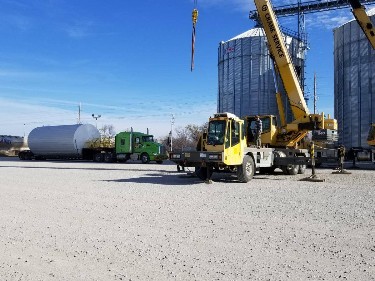
We deliver precision aerial welding in Omaha NE with unwavering focus on safety and structural integrity. Our teams ensure solid, rust-resistant joints through meticulous surface preparation and proper technique.
McMahan Industrial Services offer a full range of services including aerial welding, backed by UT/RT inspections and strict quality controls for elevated installations.
Aerial Welds Pass Inspection
Aerial welds pass inspection through quantifiable criteria: surface cleanliness (ASTM D4417 standard), electrode specification matching base metal composition, and bead geometry within ±0.5 mm tolerance.
Radiography (ASTM E94) or dye penetrant inspection (ASTM E165) are non-destructive testing methods that can find cracks in the wall that are more than 10% of the way through. Slag inclusion rates must remain below 2% by area.
Root cause analysis: improper amperage (typically 80-120 A for overhead positions) creates porosity; insufficient shielding gas flow (15-25 CFM) generates oxidation; contaminated surfaces reduce fusion strength by 15-30%.
Compliance requires documented heat input calculations, inter-pass temperature monitoring (65-150°C maximum), and hardness testing verification (Vickers HV 250-350 range for structural steel).
Visual, dimensional, and mechanical inspections are done in a certain order to make pass/fail decisions based on relevant codes (AWS D1.1, ASME Section VIII). Additionally, regular inspections are essential to ensure the ongoing safety and security of bridges while maintaining operational flow.
Precision Welds for Tall Structures
Tall structure welding requires controlled thermal input, precise joint geometry, and verified material compatibility. Critical variables include:
Material Selection: Alloy composition determines tensile strength and corrosion resistance. Stainless steel grades (304L, 316L) achieve 170-310 MPa yield strength in structural applications.
Process Parameters: Aerial welding demands shielded metal arc (SMAW) or gas tungsten arc (GTAW) processes, with amperage ranges 80-250A dependent on base metal thickness and position.
Quality Verification: Ultrasonic testing (UT) and radiographic inspection (RT) detect internal discontinuities exceeding 10% thickness. Surface inspection follows ASME Section VIII standards.
Access Protocols: Mobile welding platforms eliminate mobilization costs—typically $2,000-$5,000 per project compared to stationary fabrication requiring structural dismantling.
Systematic surface preparation (grit blasting to Sa 2.5) and fit-up tolerance control (±3mm for gap dimensions) optimize first-pass acceptance rates.
Dependable Elevated-Weld Safety Inspections
Elevated-weld safety inspections employ systematic verification protocols to identify defects before propagation. The inspection sequence comprises:
(1) pre-inspection mobile welder assessment,
(2) visual and ultrasonic testing of critical welds,
(3) documented repair history archives,
(4) engineered repair specifications for pipe fitting adjustments,
(5) competency-based training in fabrication safety standards.
This hierarchical approach establishes causal chains: defect detection → preventive intervention → downtime elimination.
Nondestructive testing methods (UT, RT, ET) enable high-confidence flaw identification at <2mm depth thresholds.
McMahan Industrial Services Protocol: Service Engagement Verification
McMahan Industrial Services initiates service engagements through three channels: phone (877-731-3193), email (akiger@mcmahanindustrial.com), and contact form portal (mcmahanindustrialservices.com/contact-us.html). Each intake generates a unique Service Order number with timestamp validation.
Project managers allocate resources based on scope, location, and availability, establishing mobilization schedules and milestone timelines. Change orders require revised estimates and schedule impact assessments prior to execution.
On-site coordination includes pre-arrival safety verification, bill of materials preparation, and daily progress logging. Non-conformances receive documented disposition and closure tracking.
Performance validation derives from Google reviews and project gallery documentation.
Explore Omaha NE Attractions
Omaha's primary attractions operate within distinct functional categories.
The Henry Doorly Zoo ranks among the top 5 U.S. zoos by annual visitation (1.8M+).
The Old Market district functions as the historic commercial core, spanning 12 blocks with 80+ retailers and restaurants.
Lauritzen Gardens comprises 110 acres of botanical collections.
The Omaha Riverfront generates economic activity through recreational infrastructure and riverfront development projects.
The University of Nebraska at Omaha serves 15,000+ students across 140+ academic programs.
Get Started
Fill out form below